In a Gartner survey of 646 B2B buyers, 67% said they prefer a rep-free buying experience. McKinsey’s 2026 B2B Pulse, which surveyed nearly 4,000 decision-makers, found that 71% of B2B companies now sell online. Among those that do, about one-third of revenue comes through digital channels. Buyers are also comfortable spending: 73% would place an order above $50,000 online, up from 59% in 2022. For a company that sells to other companies, the web application is now where much of the selling happens.
A basic website can’t carry that load. Business buyers need contract pricing, tax rules, approval steps, order history, and stock numbers that match the warehouse. That is the job of a web application connected to your ERP and CRM. When your systems disagree, buyers notice. McKinsey found that inconsistent information across teams is now the top reason buyers switch suppliers. The same Gartner survey also found that 69% of buyers see conflicts between a seller’s website and what the seller tells them.
This is why the company you hire should be B2B focused. A B2B web app has several users per account, role-based access, custom price lists, reorders, and invoices. It also has to plug into the systems running behind the scenes. A team that mostly builds consumer apps tends to treat these as add-ons. McKinsey makes a similar point: digital commerce is about much more than taking online orders. It means connecting your data, making pricing and availability clear, and making ordering easy. Companies that skip this work fall behind.
The gap between companies that get this right and those that don’t is already showing. This guide compares seven companies on B2B focus, the types of apps they build, tech stack, security, notable clients, and who should look elsewhere.
Methodology 🔬
The companies listed first or last is not a ranking factor and the order is random. Our out-of-5 ratings for best B2B web application development company were created by using AI to evaluate every company against set criteria, including market positioning, security features, B2B focus, and client work and more. Please note that the content itself and the final publication that goes out is written and edited by the Triserv 360 team. Additionally, to ensure the information is latest and correct, every detail came straight from the companies' own websites.
1. Triserv 360

Triserv 360 is a b2b web application development with 27+ years in the industry and has delivered 650+ projects so far. Delivered projects include ERP systems, CRM platforms, B2B ordering portals, e-commerce stores, and admin dashboards. The company is based in Kanpur, India, and serves clients all over the globe. The founder, Shamshad Ahmad, leads strategy, technology, and consulting himself. Clients deal with the person making the decisions, so there is no chain of account managers to get through.
The work is easiest to judge from what has shipped. One ERP Triserv 360 built tracks machines, service schedules, warranty claims, employee records, leave, loans, and company assets in one place. A B2B ordering portal handles bundled pricing, tax codes, carts, and order history for trade buyers. A back-office CMS lets admins manage products, brands, categories, and enquiries. A survey app gives field teams role-based dashboards and performance reports.
Triserv 360 also builds and runs its own product, Workorio, a lead management and business management platform. So the team doesn’t only build software for other people. It has skin in the game, because it has to keep a large, multi-module web app working for its own users. For a buyer, that is useful proof: the people building your app already handle updates, support, and uptime on their own product.
A web app needs more than code, and Triserv 360 covers the rest. It sets up cloud environments on AWS, Azure, and Google Cloud and handles backup and disaster recovery. Companies without an IT head can bring in a fractional CIO. Hosting, maintenance, and support continue after launch. Buyers can also hire a dedicated team or add developers to their own team. Check our case studies to learn more.
Positioning
Founder-led technology company that builds ERP, CRM, and custom web apps for growing businesses.
Best for
Small and mid-size businesses that want ERP, CRM, or a custom web app, plus cloud setup and long-term support, from one team.
HQ
Kanpur, Uttar Pradesh, India
Are they B2B focused?
Yes, it builds ERP, CRM, and business software, and its client list is made up of companies.
Tech stack
Cloud work on AWS, Azure, and Google Cloud, plus Microsoft 365 migration.
Types of web apps they build
ERP systems, CRM and lead management platforms, B2B ordering portals, e-commerce platforms, admin CMS dashboards, and data collection apps.
Security and compliance
Backup and disaster recovery, data encryption, and cybersecurity consulting.
Notable clients
Apex ather, Trilegal, Sabyasachi, Coca-Cola Amatil, BorisVeins, Wildcraft, Apollo Pharmacy, Acxiom Consulting, Calzado India, Senco Gold & Diamonds, and more PhoenixBev.
Years in business
Founded in 2020. The founder has 27+ years of IT experience.
Who should not hire them?
Triserv 360 works best with companies that want development and marketing under one roof for the long term. If you need a small project or a single app built once and handed off, a freelancer or boutique studio will likely be a better and cheaper fit.
2. Simform
Simform is a product engineering company, and web application development is one of its core services. It builds custom web apps from design through development, testing, and ongoing support. The team picks the technology stack based on what the client’s business needs. Its stated goal is quality apps that use resources well and keep costs low.
The page lists six web app offerings: SaaS apps, front-end development, progressive web apps, backend and Node.js work, e-commerce web apps, and custom web apps for enterprises. The SaaS service covers multi-tenant products that serve many customers on one platform. A buyer can hire Simform for one layer, such as the front end, or for the full build. Enterprise web apps get their own offering instead of being folded into a general service.
Simform also helps companies that already have software. Its developers give technology advice, modernize legacy architectures, and move systems to newer web architectures. It breaks large monolithic apps into microservices so teams can release changes on their own. This suits B2B firms that need to upgrade core software without starting over.
The delivery process is agile. Sprint planning is shared with the client’s team, and stand-ups, weekly demos, and weekly reviews keep everyone current. Code reviews before release catch memory leaks, file leaks, and performance problems. The team has worked across finance, healthcare, software, education, retail, and manufacturing.
Positioning
Product engineering company that builds custom web apps, from SaaS platforms to enterprise systems.
Best for
Mid-size and enterprise companies that need a custom SaaS product, a legacy system rebuilt, or a full web app built and supported by one team.
HQ
Orlando, Florida, USA
Are they B2B focused?
Yes, it builds both B2B and B2C apps, with a clear enterprise focus.
Tech stack
Node.js on the backend, modern front-end frameworks, progressive web app technology, and microservices architecture. Simform also holds Microsoft Azure and AI partner designations.
Types of web apps they build
SaaS platforms, enterprise web apps, progressive web apps, e-commerce apps, and analytics platforms such as a bank analytics web app for wealth managers.
Security and compliance
The web application development page lists no certifications. It describes its SaaS builds as secure and multi-tenant.
Notable clients
Bank of America, Mitsubishi Electric, FUJI FILM, Cisco, Twillio, WM Ware
Years in business
Over a decade of experience building B2B and B2C applications.
Who should not hire them?
Startups with a small budget or a simple one-time website will likely find Simform too big for the job. It is built for larger product and enterprise projects. The page also gives no pricing, so buyers who want a cost range before a sales call will not get one here.
Also read: Best B2B Mobile App Development Companies
3. Intellectsoft
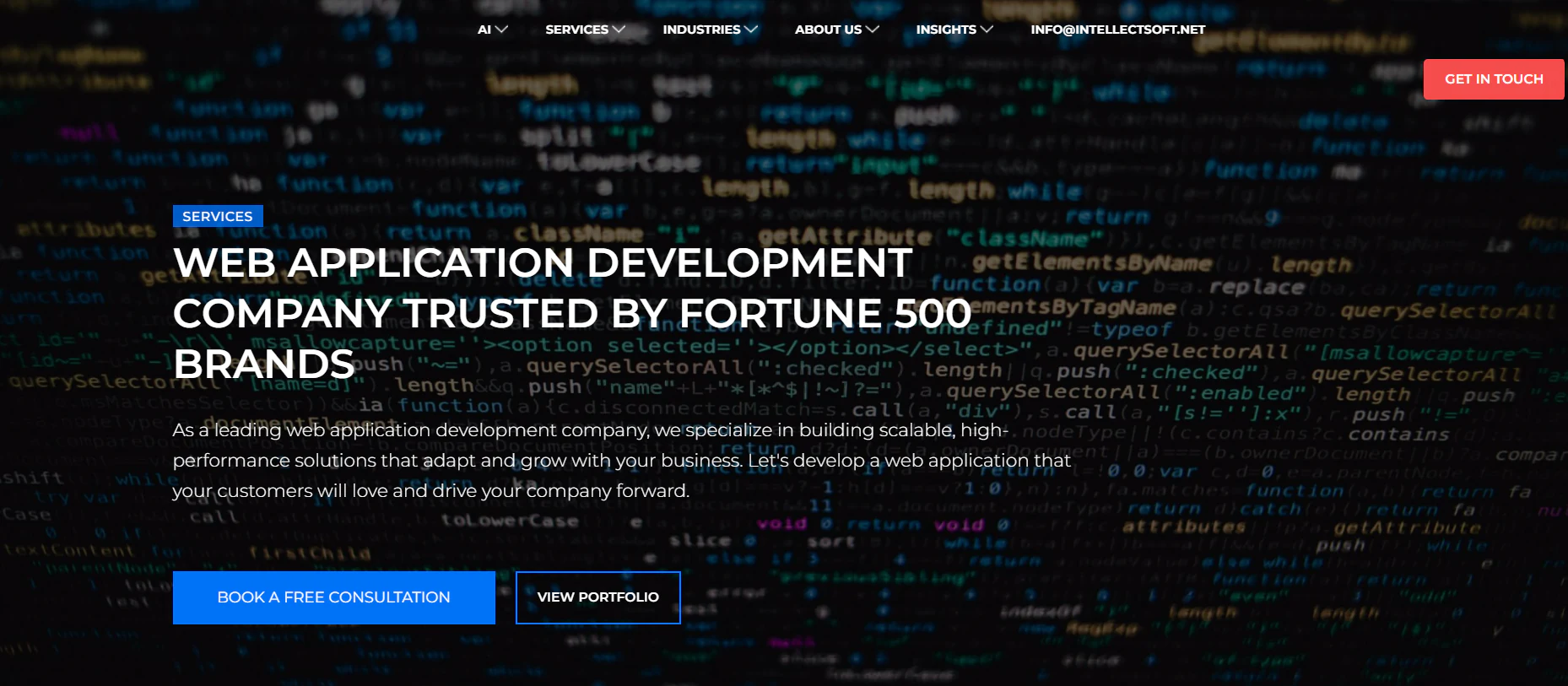
Intellectsoft builds custom web applications for mid-market companies and ambitious startups. Its web application page covers Java, AngularJS, Python, and PHP builds, along with enterprise and custom web apps. Every project starts with a senior architect who sets the technical direction and stays on it through delivery. The team says this keeps big decisions from changing halfway through a build.
What a client gets is spelled out plainly. That includes requirements analysis, UI and UX design, responsive layouts, custom features, and a secure, scalable architecture. Maintenance continues after launch. Related services cover SaaS development, e-commerce, web development consulting, and custom CRM builds. Clients can also hire a dedicated team, add staff to their own team, or start with an MVP.
The process has four stages. Kick-off turns business requirements into technical documents and first prototypes. Development runs on Scrum, with results reviewed every two weeks, then user acceptance testing and deployment. After launch, the team monitors servers, fixes bugs, and handles support. Clients can shrink the team to a small unit for later updates.
Intellectsoft also uses AI across the delivery cycle and says this gets products to market 40% faster. Its engineers sit in Eastern Europe, Latin America, and Asia Pacific, which gives programs coverage across time zones. Recent web projects include a white-label CRM platform for a network of dental clinics and a 3D design workspace that replaced five quoting tools with one.
Positioning
Mid-size software company that builds custom web apps with a senior architect leading every project.
Best for
Mid-market and enterprise companies in regulated industries like healthcare, fintech, and insurance that want an architecture-first build and a long-term engineering partner.
HQ
New York City, USA
Are they B2B focused?
Yes, it builds software for mid-market and enterprise companies and lists Fortune 500 brands as clients.
Tech stack
Java, AngularJS, Python, PHP, Symfony, Ruby, React, JavaScript, Node.js, and jQuery. Cloud work runs on AWS, Microsoft, and Google, with Snowflake and Databricks for data.
Types of web apps they build
Enterprise web apps, custom web apps, SaaS platforms, e-commerce apps, CRM platforms, analytics dashboards, and cloud-based quoting tools.
Security and compliance
HIPAA compliant, GDPR compliant, ISO 27001, and ISO 9001:2015.
Notable clients
Eurostar, Jaguar, Young Living, KJK, Melco, Sony, Naked Energy, Proteket, Archrival, IAATO, Guest Services, and NBC Universal.
Years in business
They haven't mentioned any dates on their websites.
Who should not hire them?
Companies with a small budget or a simple one-off website will likely find Intellectsoft too heavy, since its process starts with architecture and discovery. The site gives no pricing either, only a project estimate within about 3 to 5 days of a request. Its web app page also lists older tools like AngularJS and jQuery, so teams that want a clear view of its newest front-end work should ask for it early.
4. Itransition
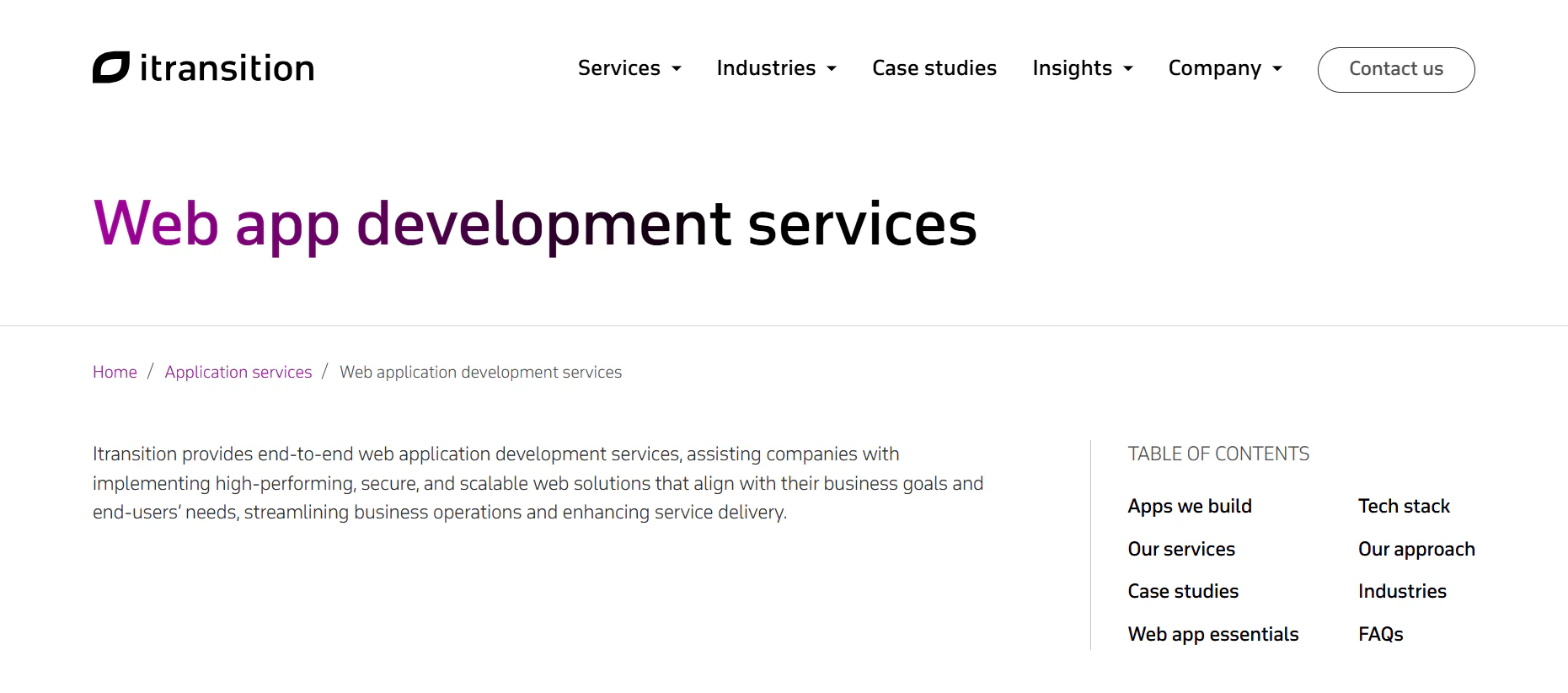
Itransition is a software company that builds web applications from the first requirements workshop through long-term support. It can deliver a full solution or join a project already underway. Its web app page lists eight types of apps: custom apps, web portals, enterprise apps, progressive web apps, SaaS platforms, e-commerce stores, analytics apps, and apps that use AI, IoT, VR, or blockchain.
The service scope has nine steps. They are business analysis, UX and UI design, architecture, front-end work, back-end work, integration, quality assurance, maintenance, and app evolution. The first step sets the budget, timeline, and a risk plan before any design starts. A buyer can pay for one stage or the whole chain.
Enterprise software is a big part of the offer. The team builds ERP, CRM, HRMS, and supply chain systems that connect to a company’s existing tools. It also builds partner and employee portals with self-service features. Partnerships with Microsoft, AWS, Salesforce, Oracle, SAP, and Atlassian back this work. Its engineers work in more than 20 industries, including finance, healthcare, insurance, manufacturing, and logistics.
Security and quality get their own section. The team uses end-to-end encryption, dynamic data masking, and multi-factor authentication. Its quality framework follows ISO 9001, and it runs unit and end-to-end tests with manual code reviews. Scaling relies on API-driven microservices and serverless setups. A talent pool of more than 3,000 IT professionals lets it bring in niche specialists when a project needs them.
Positioning
Full-cycle software company that builds enterprise web apps, portals, and SaaS platforms.
Best for
Mid-size and large companies that need a secure, integrated web platform such as an ERP, a customer portal, or a regulated-industry app.
HQ
Decatur, Georgia, USA, with an office in London, UK
Are they B2B focused?
Yes, it builds enterprise systems and business platforms across 20+ industries.
Tech stack
.NET, Java Spring, Python (Django, Flask), PHP (Laravel, Symfony), Ruby on Rails, Node.js, Go, React, Angular, Vue.js, and TypeScript. Databases include PostgreSQL, MySQL, and MongoDB. Cloud work runs on Azure, AWS, and Google Cloud, with Docker, Kubernetes, and Terraform for DevOps.
Types of web apps they build
Custom web apps, web portals, enterprise apps (ERP, CRM, HRMS, supply chain), progressive web apps, SaaS platforms, e-commerce stores and marketplaces, analytics dashboards, and AI-powered apps.
Security and compliance
ISO 27001 and ISO 9001 certified. It has also built HIPAA-compliant web apps for healthcare.
Notable clients
TradeStops, The Economist, OPED Digital Health Solutions, and AiBUY.
Years in business
Founded in 1998.
Who should not hire them?
Startups and small teams that need a quick, low-cost MVP will likely find Itransition larger than they need. Its process starts with detailed business analysis and risk planning, which suits big projects more than small ones. The page also shows no pricing, so buyers who want a cost range before a call will have to ask for it.
5. Rootstrap

Rootstrap is a nearshore product engineering company. Its web development service builds web apps and dashboards on a React and Next.js front end with APIs behind it. The team works in a component-driven way, with a real design system and typed code from end to end. Performance and accessibility count as acceptance criteria for a release, not extras added later.
The service list is short and specific. It covers web apps and dashboards, design systems, Core Web Vitals performance work, WCAG accessibility, APIs and integrations, and headless CMS setups. The team builds customer-facing apps, internal dashboards, and marketing sites that need to rank and convert. A headless CMS lets editors change content without waiting on engineers. This helps B2B companies that publish often and want to stay fast.
On the technical side, the front end runs on React, Next.js, or Astro with TypeScript and Tailwind. The back end uses Node or the client’s existing stack, connected through clean APIs. The team tracks Core Web Vitals, so speed on real devices is measured instead of guessed. Clients own the code and the infrastructure from day one.
Projects start with an AI Discovery Sprint, which Rootstrap describes as clarity before commitment. Delivery runs through its own AI-native system, where specialized agents plan, build, test, and review work against a shared record of the client’s business decisions. Senior engineers make the key calls and sign off every release. The teams are spread across the Americas and work in US time zones.
Positioning
Nearshore product engineering company that builds fast, accessible web apps and dashboards on React and Next.js.
Best for
Startups and growing B2B companies that need a front-end-heavy web product, a dashboard, or a design system built by a senior team in US time zones.
HQ
Beverly Hills, California, USA, with hubs in Montevideo, Buenos Aires, and Medellín
Are they B2B focused?
Yes, it works with startups and enterprises, though some of its clients run consumer products.
Tech stack
React, Next.js, Astro, TypeScript, Tailwind, Node.js, GraphQL, and Vercel. It is also an AWS partner.
Types of web apps they build
Customer-facing web apps, internal dashboards, design systems, headless CMS sites, and API-driven products.
Security and compliance
SOC 2 certified.
Notable clients
MasterClass, Brightwheel, BetterUp, Google, Salesforce, DoorSpace, Epson, Sony, Emeritus, and Archivo.
Years in business
Founded in 2011.
Who should not hire them?
Companies that need a large back-end system like an ERP or a deeply regulated platform will find the web page thin on that. It lists SOC 2 but no HIPAA or ISO certifications. Buyers with a small budget or a basic brochure site will likely find the senior-team model more than they need. The page gives no pricing, so cost has to wait for a call.
Also read: Best B2B Website Development Companies
6. FullStack
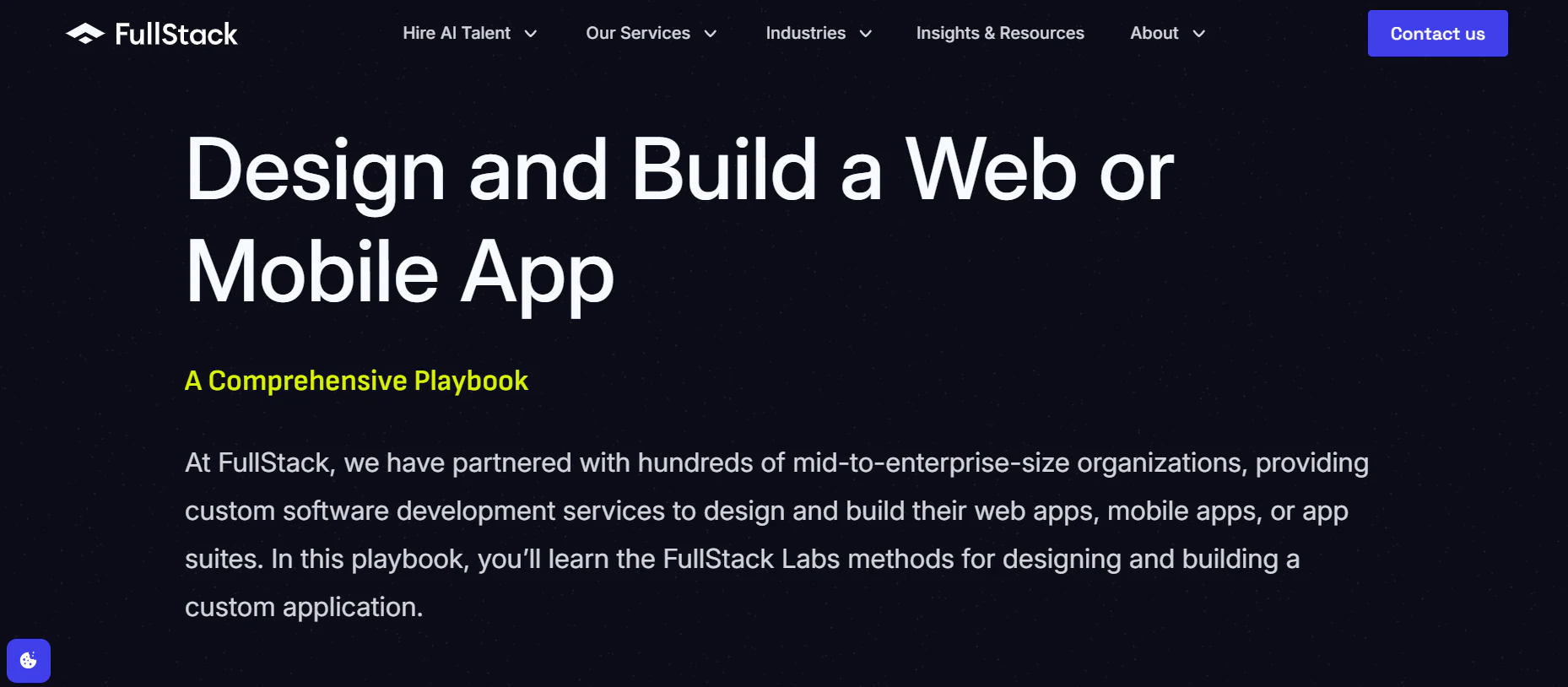
FullStack Labs is a nearshore engineering company that builds custom web and mobile apps for mid-size and enterprise organizations. Its web app content is a five-phase playbook: discovery, design, development, launch, and maintenance. Each phase lists the steps the team follows and what the client receives at the end. This makes the process easy for a buyer to picture before signing anything.
Discovery comes first. The team reviews existing research, talks to stakeholders, sets goals tied to business results like conversions and revenue, and runs a technical review of the architecture and integrations. It sometimes builds a proof of concept to test feasibility. The client gets a competitive benchmark, an architecture report, and a design brief. Scope is set early, with MVP features separated from those that can wait.
Design covers UX research, wireframes, clickable prototypes, and a design system. Most clients adapt an existing system like Material Design, which saves time and money. Accessibility is built in from the start and follows ADA standards. In development, a typical team has two senior developers, a project manager, a QA expert, a part-time designer, and a product owner. Work runs in two-week sprints, with automated tests from day one and code review before every merge.
After launch, the team runs private and public beta tests and coordinates launch day. It then offers a maintenance agreement. That covers error monitoring with tools like Sentry and Bugsnag, version updates, performance tuning, and compliance updates. Clients who want new features can add an ongoing development agreement with a product roadmap. Teams mix onshore and nearshore staff in US time zones.
Positioning
Nearshore engineering company that designs, builds, and maintains custom web and mobile apps for mid-size and enterprise clients.
Best for
Mid-size and enterprise companies that want a structured, phase-by-phase build with a dedicated senior team and a maintenance plan after launch.
HQ
The pages provided do not state this.
Are they B2B focused?
Yes, it works with mid-size and enterprise organizations.
Tech stack
The pages provided name no front-end or back-end frameworks. They list partnerships with AWS, Microsoft, Google Cloud, Snowflake, and Databricks, and monitoring tools like Sentry, Bugsnag, and ESLint.
Types of web apps they build
Custom web apps, mobile apps, and app suites, plus AI-powered tools and agentic workflows on the main site.
Security and compliance
Shows an AICPA SOC badge. It also designs for ADA accessibility and updates apps for regulatory compliance during maintenance.
Notable clients
Uber, Domo, GoDaddy, Hinge Health, Stanford University, Britannica, Procore, Ekso Bionics, Benjamin West, Lux Research, Deloitte, Carrier, Siemens, and City of Sacramento.
Years in business
We couldn't find any information on their website.
Who should not hire them?
Buyers who want a web-only specialist with a named tech stack will not find one here, since the content covers web and mobile together and lists no frameworks. The homepage now leads with AI engineering and forward deployed engineers, so the web app work is not the main pitch. The standard team of six is also heavy for a small one-off project, and the pages give no pricing.
7. Radixweb
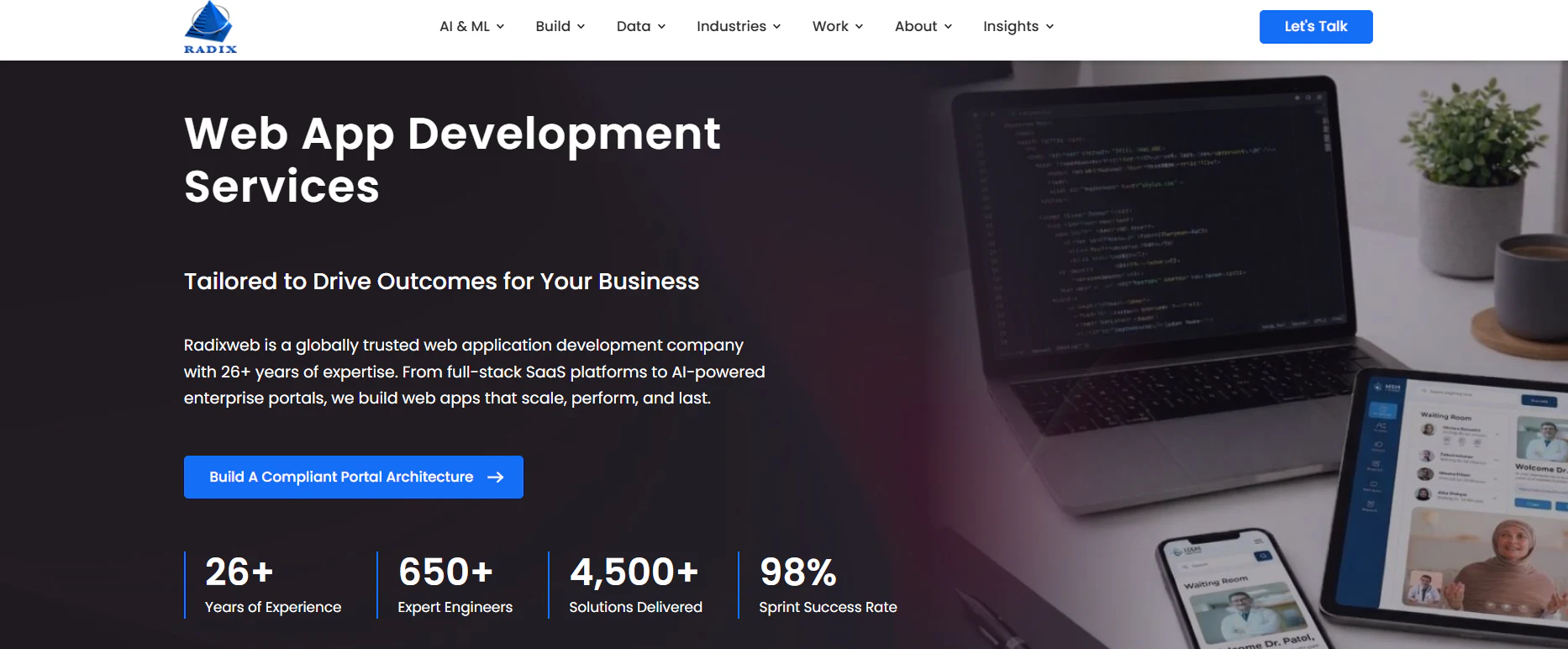
Radixweb builds custom web applications, from SaaS platforms to enterprise portals. Its service scope covers the full lifecycle: strategy and consulting, UI and UX design, cloud-native development, API integration, security testing, and long-term support. The page argues for custom web apps over off-the-shelf SaaS. Its case is that a custom app encodes your actual workflows, scales on your terms, and leaves you owning the code.
The page spells out eight app types: multi-tenant SaaS, enterprise apps, e-commerce, web portals, progressive web apps, AI apps, dashboards, and app modernization. For each type, it lists who the app is best for and the usual stack. The SaaS build includes tenant isolation, a Stripe or Braintree billing engine, and infrastructure that scales to 100,000 users. Each type gets its own architecture and delivery plan.
The delivery process has six phases: discovery, design, development, QA and security, deployment, and support. Every phase ends with named outputs like an architecture blueprint, test reports, and a disaster recovery runbook. Security work such as threat modeling, SAST, DAST, and penetration testing runs inside every sprint. Launch comes with 60 days of free support. Clients can then move to an SLA-backed maintenance plan run by the engineers who built the app.
Radixweb also builds AI into web apps. It adds LLM features, document search over a company’s own knowledge base, and multi-agent workflows with human approval steps. A senior architect leads each engagement as the main technical contact. Buyers can choose a fixed scope, a dedicated team, or staff augmentation. The team serves healthcare, fintech, HR tech, legal tech, manufacturing, and more.
Positioning
Custom software company that builds scalable web apps, from SaaS platforms to AI-powered enterprise portals.
Best for
Mid-size and enterprise companies in regulated fields like healthcare, fintech, and legal tech that want a custom web app with security and compliance built in.
HQ
Ahmedabad, India, with offices in the USA, Canada, Australia, and Morocco
Are they B2B focused?
Yes, it builds enterprise systems, B2B platforms, and SaaS products for business customers.
Tech stack
.NET Core, ASP.NET MVC, Python, Node.js, React, and Angular on the application side. PostgreSQL and Redis for data. AWS, Azure, and Kubernetes for cloud, with REST and GraphQL APIs.
Types of web apps they build
Multi-tenant SaaS platforms, enterprise apps, e-commerce platforms, web portals, progressive web apps, AI apps, dashboards, and modernized legacy apps.
Security and compliance
ISO 27001:2022, SOC 2 Type II, ISO 9001:2015, OWASP ASVS aligned testing, HIPAA ready, and GDPR aligned.
Notable clients
The pages provided name no clients. The logo strip did not copy over.
Years in business
26+ years.
Who should not hire them?
Companies that only need a simple website or an off-the-shelf tool will find the custom, security-first approach more than they need. The page also leans hard toward custom builds over SaaS, so ask for a neutral view if you are still deciding between the two. Its listed back-end stack centers on .NET, Python, and Node.js, so teams set on Java or Ruby should check first. No pricing appears on the page.
Triserv 360 rating: 4.5
Best B2B web application development companies comparison table
Frequently asked questions (FAQ)
1. Which are the best B2B web application development companies in 2027?
Some of the best B2B web application development companies in 2027 include Triserv 360, Simform, Intellectsoft, Itransition, Rootstrap, FullStack Labs, and Radixweb. The right choice depends on your project requirements, technical expertise, industry experience, budget, and long-term support needs.
2. How do I choose the right B2B web application development company?
Evaluate companies based on their experience with B2B applications, technical capabilities, portfolio, client references, security practices, development process, and post-launch support. Also check whether they have built applications similar to your requirements, such as ERP systems, CRM platforms, SaaS products, or B2B portals.
3. How much does it cost to develop a custom B2B web application?
The cost depends on application complexity, features, integrations, technology stack, security requirements, and development time. A simple business dashboard will generally cost less than a custom ERP, multi-tenant SaaS platform, or enterprise application with multiple integrations. Request a detailed project estimate before choosing a development partner.
4. What types of web applications do B2B development companies build?
B2B web application development companies typically build ERP systems, CRM platforms, SaaS applications, customer portals, vendor management systems, B2B ordering platforms, inventory management software, analytics dashboards, and workflow automation tools.
5. What should I look for in a B2B web application development company's portfolio?
Look for completed projects that demonstrate experience with business-critical applications, complex workflows, third-party integrations, user management, reporting, and data security. Relevant case studies and measurable project outcomes can help you assess whether a company can handle your requirements.
6. Which technologies are commonly used for B2B web application development?
Common technologies include React, Angular, Node.js, Python, Java, .NET, and PHP. Cloud infrastructure such as AWS, Microsoft Azure, and Google Cloud is also widely used. The right technology stack depends on the application's architecture, scalability, integrations, and maintenance requirements.
7. How long does it take to develop a custom B2B web application?
Development timelines depend on the scope and complexity of the application. A basic business application may take a few months, while enterprise platforms involving multiple modules, integrations, and security requirements can take considerably longer. Discovery, design, testing, and deployment should all be included in the project timeline.
8. Should I choose a custom B2B web application or an off-the-shelf SaaS solution?
Off-the-shelf SaaS solutions work well when your business processes fit existing features. Custom web applications are more suitable when you need specialized workflows, complex integrations, specific user permissions, or greater control over functionality and future development.
9. Why is post-launch support important when hiring a web application development company?
B2B applications often support everyday business operations, so ongoing maintenance is essential. Post-launch support helps address bugs, security vulnerabilities, performance issues, infrastructure changes, and new feature requirements. Check whether the development company offers maintenance agreements, monitoring, backups, and technical support.
10. What security certifications should I check when hiring a B2B web application development company?
Depending on your industry and application requirements, look for certifications and compliance standards such as ISO 27001, SOC 2, and HIPAA. You should also evaluate encryption, access controls, authentication, security testing, backup policies, and disaster recovery practices. Requirements vary by industry and the type of data your application handles.
11. Can a web application development company also provide cloud hosting and application maintenance?
Yes. Many full-service web application development companies also provide cloud infrastructure setup, deployment, hosting, monitoring, backup management, disaster recovery, and ongoing maintenance. Working with one team for development and infrastructure can simplify long-term application management.
Editorial notes by Triserv 360 team 📰
We take listing the companies that deserve the spot in our humble publication very seriously. That’s why we feel it’s a great practice to be transparent about our process and methods. We come up with the final list based on the B2B factors we mentioned above. Another major ranking factor is having the core service web page. Although it’s negotiable — we highly anticipate it because a lot of our research can be done directly from the said service page — tech stack, clients, how your process works, and so on — that page makes it easier to judge you fairly based on your own information. Your rankings might tank if we did not find any information mentioned that makes up our list like years in business, clients you’ve worked with and so on. If you feel we missed an important information or misrepresented something, please reach out, we’ll have a look.
TL;DR
Best B2B web apps development agencies: Triserv 360, Simform, Intellectsoft, Itransition, Rootstrap, FullStack, Radixweb
Got a project in mind? Let's talk!
Connect with our architects for a high-performance evaluation, technology modernization blueprint, or custom engineering strategy.