Your buyers make most of their decision before they talk to you. In the 6sense 2026 Buyer Experience Report, 85% of buyers had largely or entirely set their decision criteria by the time they first contacted a seller. The vendor they favored going in won 82% of the time.
That is the case for B2B content marketing in two numbers. If buyers pick a shortlist before the first call, the content they read decides whether you are on it.
Gartner adds to this. Its survey of 646 B2B buyers, run in August and September 2025, found that 67% prefer a rep-free buying experience. Content has to do the early selling.
Most teams struggle to do this well. In the Content Marketing Institute (CMI) 2027 B2B survey of 861 marketers, 88% said their organization uses AI content tools. Of those marketers, 78% said AI helped with speed. Only 17% said it helped with quality. And only 12% rated their overall marketing as highly effective.
Speed is cheap now. Trust is hard to earn. This guide shows you how to build B2B content that earns trust, ranks in search, gets cited in AI answers and shows up in your pipeline.
Chapter 1: what Is B2B content marketing and why it matters in 2027
What is B2B content marketing?
B2B content marketing is the practice of creating useful content for businesses that may buy from you. The content answers questions, solves problems and builds trust over time. Blog posts, case studies, reports, videos, webinars, newsletters and LinkedIn posts all count.
The content does not sell directly. It helps a buyer learn, compare and feel safe about a choice.
Here is a simple example. A company that sells warehouse software publishes a guide on how to cut picking errors. A warehouse manager reads it and shares it with the operations head. Three weeks later, the operations head asks for a demo. The guide did the first round of selling.
B2B vs. B2C content marketing: Key differences
B2B and B2C content marketing share the same basics. The audience, the buying process and the style of content are different.
Why B2B content marketing matters in 2027
The old B2B equation was simple. Rank in search, get the click, capture the lead and let sales close. In 2027 that chain has weak links. Buyers decide earlier, more people weigh in, and search engines answer questions without sending a visit. Content now carries most of the weight in the sale. Here is why.
1. B2B buying is a 10-person group decision
6sense found that the average buying group has about ten people. Each person asks a different question.
- The finance head asks what it costs and when it pays back.
- The IT head asks about security and integration.
- The user asks whether it will make daily work easier.
- The final approver asks whether this is a safe choice.
One brochure cannot answer all of them. A set of focused pieces can.
There is a sharper insight for service providers. In the same research, 62.1% of services buyers said agreeing that the category was worth funding was harder than choosing a vendor. For software buyers the figure was 52.7%. So before the buyer compares you with anyone, an internal champion has to win a budget argument. Content that helps that champion make the case, such as cost breakdowns, ROI examples and risk checklists, answers the question most vendors skip.
2. Buyer research never stops between evaluations
6sense reports that 96% of buyers keep up with their category between evaluations. They read before a project exists. When the budget finally opens, they already know who they trust.
This favors always-on content over short campaign bursts. A campaign ends. A library of useful guides keeps working after the campaign is over.
3. Zero-click search and AI answers reduce website visits
This is the biggest shift. A Forbes column by Stephen Diorio (May 2026) pulls together several data points on it:
- Nearly 60% of Google searches end without a click to an outside website, according to SparkToro and Datos research.
- AI summaries cut click-through rates on informational content by 34% to 54%, according to multiple studies the column cites.
- Gartner has forecast that traditional search traffic will fall 25% by 2026 as people shift to AI assistants.

The column makes one more point that matters for content. AI tools do not rank pages the way a classic search engine does. They retrieve small chunks of text, compress them and decide what goes into the answer. Clear structure, direct answers and agreement with other trusted sources help a chunk get picked. Keywords matter less.
The same column cites an academic study of 24,000 AI search queries. It found that AI search tends to concentrate visibility among authoritative brands and give smaller or lower-trust sources less exposure. Small agencies and vendors should take this seriously. Authority is now a ranking factor in a wider sense.
Keep the numbers in balance. 6sense found that 81% of buyers use LLMs. Only 17% to 21% call them influential in the final decision, and only 26% use them to find new vendors. AI visibility is one channel in a longer journey. It deserves a plan, and it does not replace the rest.
What changes in practice is how you measure. Your brand can be named in an AI answer with no click and no form fill. Add a "How did you hear about us?" field to your forms so that invisible influence shows up.
4. Buyer trust is the scarcest resource in an AI-flooded market
AI has made content cheap to produce. In the Content Marketing Institute (CMI) 2027 survey of 861 B2B marketers, 88% said their organization uses AI content tools. 78% said AI helped with speed. Only 17% said it helped with quality. Only 12% rated their overall marketing as highly effective, and 65% felt more pressure to publish faster over the past year.
The result is a flood of similar content. Buyers can tell. When everyone can publish fast, a clear point of view from a named expert stands out.
CMI also asked what builds trust. 64% of marketers said useful, practical information. 59% said demonstrated expertise. 50% said customer stories. All three come from real work, and AI cannot fake them well.
5. Third-party proof and community reviews carry more weight
Buyers lean on voices outside your company. Between evaluations, 31.4% of buyers use product review sites and 31.3% use industry publications. Forrester's 2025 State of B2B Content survey found that content decision-makers turn to third parties such as review sites, influencers and successful customers to back up their choices.
The Forbes column adds that LLMs seem to give extra weight to customer advocacy and community content, such as Reddit and Quora threads. The takeaway is practical. Collect reviews. Publish customer stories with real names. Answer questions in communities where your buyers ask them.
6. Content commands nearly 30% of B2B marketing budgets
The Forbes column reports that B2B marketers put about 28% to 29% of their marketing budgets into content, and more when the offer is complex. Gartner's 2026 CMO Spend Survey puts total marketing budgets at 7.8% of company revenue. With that much money flowing into content, weak content is an expensive habit.
7. How the B2B content marketing playbook shifts in 2027
Chapter 2: how to build a B2B content marketing strategy in 7 steps
A content marketing strategy is a short, written plan. It answers five questions: who you write for, what you publish, where you share it, who does the work, and how you will know it is working. If your plan cannot answer all five in two pages, it is not a strategy yet. It is a wish list.
Most B2B teams skip this and go straight to "let's write four blogs a month." Six months later they have 24 articles, 300 visits a month and no demo requests. The steps below fix that by working backwards from revenue. Follow them in order, because each step depends on the one before it.

Case study example: Northwind Digital's B2B content plan
To make this real, we will follow a fictional company, Northwind Digital: a 12-person agency in Pune that builds websites and ERP integrations for mid-size manufacturers. It has no big budget. It has two people who can work on content, about 20 hours a week between them. Every table and number below is built around that company, so you can copy the method and swap in your own data.
Step 1: Choose one revenue-linked business goal
Every content plan fails the same way: it tries to do everything. Awareness, leads, SEO, social growth, thought leadership, all at once. Pick one primary goal. Add at most one supporting goal.
A good goal has four parts: a number, a deadline, a source and a link to money.
Weak goal: "Increase brand awareness." Strong goal: "Generate 40 qualified demo requests per quarter from content by Q3 2027, up from 6."
How to turn revenue into a content goal (worked backwards)
Start from the money you want and work backwards through the funnel. Here is the maths for Northwind.
Now the goal is concrete. Northwind gets 1,800 visits a month today. It needs about 3,000, and those visits must come from buyers, not students. Without this maths, "get more traffic" is meaningless.

B2B content goal options by company stage
Common mistakes in Step 1
- Choosing a goal that marketing controls but sales ignores. Agree on the goal with sales, in writing.
- Counting traffic as the goal. Traffic is a means. Pipeline is the goal.
- Setting a 30-day goal for a 4-month sales cycle. Match the goal window to your cycle.
Step 2: Define your ideal customer profile (ICP) and buying group
B2B buying is a group decision. Industry research from Gartner has found that a typical buying group for a complex solution involves roughly six to ten people. Each has different fears, and each reads different content. If you write for only one of them, the other five can block the deal.
Part A: Define your ideal customer profile (ICP)
Write an ideal customer profile in one table. Use real customers you want more of, not an imagined average.
Trigger events deserve special attention. Buyers rarely start a search for no reason. Something happens first. Content that speaks to the trigger ("Your ERP contract is ending in 6 months: a migration checklist") reaches buyers at the exact moment of need.
Part B: Map every role in the B2B buying group

Part C: Build buyer personas from real sales evidence
A persona invented in a meeting is fiction. Use this checklist to build one from facts:
- Read the notes of your last 10 won deals and 5 lost deals. Note the job titles on each call.
- Interview 5 customers for 20 minutes each. Ask: "What did you search for before you found us?" and "Who else had to approve this?"
- Ask sales: "Which three questions come up on nearly every call?"
- Check your CRM for the job titles of people who filled forms versus the ones who signed.
Step 3: Collect real buyer questions from sales, search, and AI
This step produces your best content ideas, and it costs almost nothing. The rule is simple: mine questions, do not invent topics.
The four-source buyer question system
How to mine low-hanging keywords in Google Search Console
Open Search Console, go to Performance, and filter queries with more than 50 impressions and a position between 8 and 30. These are pages Google already thinks are somewhat relevant. A better page on the same topic can move them to page one faster than starting from zero. This is often the quickest win for small B2B sites.
How to audit AI tools for buyer questions and brand visibility
Buyers increasingly ask AI tools before they ask Google. So do this test, and repeat it quarterly:
- Type 10 buyer questions into ChatGPT, Gemini and Perplexity. Example: "We run a 150-person auto-parts factory. How do we choose between SAP Business One and a cheaper ERP?"
- Record which brands and sources the AI mentions.
- Record what is missing. Gaps in AI answers are gaps your content can fill with first-hand detail.
- Note whether your brand appears at all. If it does not, that is your baseline.
Each "gap to fill" becomes a content idea with a built-in angle: the real numbers and the real examples that no one else has published.
The prioritization filter: Score questions by buyer value and first-hand expertise
Score every question from 1 to 5 on three tests, then multiply.
Write the 100s first. Skip the 4s and the 2s. First-hand experience wins. Generic advice loses, and in an AI-search world, generic advice is exactly what gets summarised away.
Step 4: Build SEO topic clusters and prioritize high-intent keywords
An unplanned blog is a list of unrelated posts. A planned one is a set of topic clusters. Each cluster has one pillar page (the broad guide, like this one) and 5 to 10 supporting articles that go deep on one sub-topic and link back.

Example B2B topic cluster for Northwind Digital
Prioritize B2B keywords by buyer intent, not search volume
The order to publish in: Decide first, then Switch, then Compare, then Learn. Most beginners do the opposite. They write "What is ERP?" first, compete with giants and get no leads. Buyers who search "ERP implementation cost" are close to a decision.
Why low-volume B2B keywords drive high-value pipeline
B2B keywords often have tiny search volume. Compare:
One converting visitor from a 50-search keyword can be worth ₹8 lakh. One thousand students are worth nothing. Search volumes here are illustrative. Check yours in a keyword tool before you commit.
B2B keyword selection checklist
- Does a buyer type this when they are close to deciding?
- Can we write something from real experience?
- Is the top page weak, outdated or generic?
- Is there a natural next step (a form, a calculator, a call) on the page?
If you answer yes to three of four, add it to the list.
Step 5: Choose high-converting B2B content formats
The format is part of the strategy. A blog post cannot do every job. Match the format to the goal and the buyer.
6 B2B content formats that build trust and convert buyers
1. The pricing guide: Most B2B companies hide prices. The ones that publish honest ranges win trust and filter out poor-fit leads. Even a range such as "Projects like this usually cost ₹5 to ₹15 lakh, and here is what moves it" beats silence.
2. The calculator: An ROI or cost calculator gives buyers something to take to their CFO. It also captures data about their size and needs, which helps sales.
3. The customer story, done properly: Skip "Customer X loved us." Use this structure instead:
4. Original research: A small survey of 50 to 100 people in your niche is enough. Publish the data, the method and the sample size. Original data earns links and gets cited by other writers, and by AI tools.
5. Objection pages: Take the hardest question from your sales calls ("Why are you more expensive than X?") and answer it honestly in a public page. Sales can send it before the call even starts.
6. Short video and founder-led content: Short clips of a real expert explaining one idea tend to build trust faster than polished brand videos. A 90-second video on "3 mistakes in ERP data migration" is cheap and credible.

How to use AI-generated content without losing buyer trust
AI tools can speed up outlines, editing and repurposing. They cannot supply your experience, your numbers or your opinions. If your article could have been written by anyone, it will be treated as interchangeable by readers and by search engines. Use AI for the first draft of structure. Add the part only you know: the failed project, the real cost, the unusual lesson.
Step 6: Plan multi-channel distribution before you write
Write the distribution plan first. The most common waste in B2B marketing is a polished article that no one sees, what we call a content graveyard. A useful rule of thumb many teams follow: spend about as much time promoting a piece as creating it.
B2B content distribution plan template
The 1-to-10 B2B content repurposing framework
One strong piece should become about ten smaller pieces. Take the Northwind pricing guide:
How off-site distribution boosts AI search visibility
AI answer engines pull from pages that are clear, specific and cited elsewhere. So distribution now has a second job: getting mentioned on trusted sites. Practical steps:
- Get quoted in industry newsletters and association pages.
- Publish original data that others will reference.
- Keep company details consistent on directories and profiles.
- Add clear headings, short definitions and tables, because pages that are easy to parse are easier to cite.
Step 7: Build a sustainable content calendar around team capacity
A calendar that ignores capacity fails by week three. Start from hours, not ideas.
The capacity formula:
Hours available per week ÷ hours per piece = pieces per week
For Northwind: 20 hours ÷ 10 hours per researched article = 2 articles per week at most. But distribution needs time too. A safer plan is 1 pillar piece and 1 smaller asset per week.
Time breakdown: What one researched B2B article actually takes
Content production roles and ownership template
Give every piece one owner, plus a due date, a reviewer and a distribution task.
Sample 90-day B2B content calendar

Weekly B2B content publishing rhythm
How to measure B2B content strategy across 3 layers
Track three layers. Many teams only track the first, which is why they cannot prove value.
Because B2B cycles are long, add leading indicators: repeat visits, pricing page views, calculator uses, replies from sales that mention content. These move before revenue does.
Example 90-day B2B content marketing dashboard

Seven mistakes that sink B2B content strategies
Your 7-step B2B content strategy checklist
- One goal with a number, a date and a revenue link
- ICP written, buying group mapped with real evidence
- 30 or more buyer questions collected from four sources
- Topics grouped into clusters, keywords chosen by intent
- Formats matched to goals
- Distribution plan written for each piece before drafting
- Calendar built from capacity, with owner, due date, reviewer and distribution task
Chapter 3: B2B Buyer Journey Mapping and High-Performing Content Formats
How to map B2B content to every stage of the buyer journey
Buyers move through stages. They need different content at each one. Here is a simple map.
Most teams over-invest in the awareness stage. Late-stage content, such as case studies and objection pages, often has the shortest path to revenue.
9 proven B2B content formats that drive pipeline
No single format wins. Pick three or four and do them well.
1. Pillar guides and in-depth blog posts
Long guides rank in search and feed AI answers. They also give sales something useful to send. Write them around one clear question.
2. Comparison and "best of" buyer guides
Buyers search for these when they are close to a decision. Be honest and show your criteria. At Triserv360, we publish comparison guides such as our B2B web development companies guide, theB2B website development companies list and theB2B mobile app development companies guide. Each one explains how to judge providers, not just who to pick.
3. Customer case studies with measurable results
A good case study names the client, states the problem, shows what was done and reports the result. Buyers use them to check your claims. See how this works on our case study pages for A-Softech, MRC and Acxiom Consulting.
Our own client work shows the pattern. Each case study answers one doubt a buyer has:
- A-Softech (SAP and IT consulting, Kenya). The team had years of SAP experience, but the old website did not show it. We built a dedicated page for each service area and posted on LinkedIn, Facebook and Instagram about topics enterprise buyers care about. The lesson is that buyers check you online before they contact you. Depth on the page gives them the confidence to reach out.
- MRC (B2B hardware wholesale). Buyers dealt with offline inquiries and scattered catalogs. We built a searchable catalog with category filters and bulk ordering. The lesson is that information buyers can find fast works as content too.
- Acxiom Consulting (ERP consulting). SAP and Microsoft Dynamics services are hard to judge from the outside. We grouped them into a clear service structure with industry-specific sections and case study showcases. The lesson is that complex services need simple structure.
4. Original industry research and surveys
A small survey or a dataset from your own work gives people something to cite. Even 50 responses can make a useful report if you describe the method clearly. Publish the main findings in a free article, so search engines and AI tools can read it.
5. Webinars and short-form expert video
Video works well for demos, expert talks and customer stories. Cut one webinar into short clips for LinkedIn and email.
6. Founder and subject-matter expert LinkedIn posts
Posts from named experts reach buyers and their colleagues. People trust people more than logos.
7. Segmented B2B email newsletters
A newsletter keeps you in front of buyers who are not ready yet. Segment by role or industry when you can.
8. Free interactive tools and ROI calculators
An ROI calculator or a simple checker helps a buyer build an internal case. It also earns links.
9. Sales enablement one-pagers and battlecards
One-pagers, comparison sheets and answers to common objections help sales in live deals. Ask sales which pieces they actually use.
Chapter 4: B2B SEO and AI Search Optimization (GEO)
How to optimize B2B content for traditional SEO
Search is where many B2B buyers begin. Good SEO makes your content easy to find and easy to trust.
1. Build interconnected topic clusters
Publish one pillar page for a broad topic. Add supporting articles for each sub-question. Link them to each other with clear anchor text. This shows search engines how your expertise fits together. It also helps readers find their next answer.
2. Cover the full search intent and add original insights
Look at what already ranks for your keyword. Note the headings and subtopics. Cover all of them, then add something they miss, such as your own data, an example or a template. Google says it has no preferred word count. Length should follow the topic.
3. Demonstrate E-E-A-T with named experts and citations
Google's guidance asks for helpful, reliable content made for people. It also says that showing who created the content helps readers judge experience, expertise, authority and trust. Add an author name, a short bio and sources for your claims.
4. Master on-page SEO fundamentals
- Put the main keyword in the title, the first 100 words and one H2.
- Write a clear meta description of about 150 characters.
- Use short URLs.
- Add descriptive alt text to images.
- Use tables and lists where they help.
- Add an FAQ section that answers real questions.
5. Fix technical SEO and site performance basics
A fast site, mobile-friendly pages and clean structure help every piece of content. If you need help here, ourSEO services cover technical audits, content and link building for B2B brands.
6. Strengthen internal linking across service and blog pages
Link each new article to related pages on your site. Link older posts to new ones. Use natural anchor text. This spreads authority and keeps readers moving.
7. Refresh and consolidate outdated content every 6 months
Review your top pages every six months. Refresh stats, fix broken links and add new sections. Merge or remove pages that no longer help your goal. Google warns that a large number of thin pages does not improve a site.
How to optimize B2B content for AI search engines (ChatGPT, Gemini, Perplexity)
Buyers now ask ChatGPT, Gemini, Perplexity and Google's AI features for vendor advice. The base for AI visibility is the same as for SEO. Clear, trustworthy and original content gets cited more often.
Use these habits:
- Answer the question early. Put a direct answer in the first two sentences under each heading.
- Use clear headings. Write headings as the questions buyers ask.
- Add tables and FAQs. Microsoft's guidance recommends clear headings, tables, FAQ sections and examples with data.
- Cite your sources. Name the study, the publisher and the date.
- Show who wrote it. Add an author bio with credentials.
- Publish original data. Unique, first-hand content is hard to copy, and Google says it will likely matter more than any other tip in its guidance.
- Keep pages crawlable. Do not hide key content behind scripts or forms.
- Update often. Fresh pages look more reliable.
A warning here. Do not assume that good SEO gives you AI visibility. They overlap, and they are different. Test it. Ask AI tools the 10 questions your buyers ask. Note which brands appear. Repeat each month.
Also keep the numbers in view. As noted above, only 17% to 21% of buyers call LLMs influential in the final decision. Treat AI search as one channel in a larger plan.
Chapter 5: B2B content distribution and ethical AI workflows
How to distribute B2B content across high-trust channels
Publishing is half the job. Distribution puts your work in front of buyers where they already look.
The 6sense research shows where buyers go between evaluations. Your own website is the top source. Events, review sites and industry publications follow. LLMs come last.

Two channels deserve a closer look.
- LinkedIn.
Start by optimizing your LinkedIn profile. Get your profile "url" optimized — keep the same name as on every other social media.
Then find a LinkedIn title that works. Remember that whether it's title, about section, experience section and so on - everything should tell the same story and be SEO optimized.


Don't miss out on the LinkedIn featured section, probably one of the most important real estate. Have your products pages or most important landing pages pinned here.

My LinkedIn was not doing good. In fact, I was getting zero likes — yikes! So we started from ground up, deleted hundreds of posts, optimized whole profile, changed profile picture, banner, featured section — you name it.
And then started posting story-based posts. Genuine storytelling from real life experiences and started getting decent reach. Checkout my LinkedIn to read more.
- Google Business Profile
Many B2B buyers still search locally for vendors, such as "IT company in Kanpur." A complete profile with reviews and updates helps you appear in those searches. Learn more about our Google Business Profile services.

And do not sleep on Google business profile. Try to complete it 100% and keep updating new posts on your GMB. Try to get genuine reviews as well.

And if you don't mind getting free traffic and SEO juice from other search engines like Google Bing, sign up for Bing places. You don't need to create the profile from scratch, just use the "important from google" option. Likewise, you can also get your profile verified or claimed on Apple maps.
How to use AI in B2B content creation without losing buyer trust
AI helps with research, outlines and first drafts. It saves time. It also produces generic text if you let it.
The CMI data shows the risk. Marketers credit AI with speed far more than with quality. Google also says that mass-producing pages without adding value may break its spam policy on scaled content.
A safe workflow looks like this:
- Use AI to gather sources and draft an outline.
- Have a subject expert add real experience, examples and opinions.
- Check every fact and stat against the original source.
- Edit for plain language and a human voice.
- Name the expert who stands behind the piece.
Buyers can spot filler quickly. Your own experience is the edge that AI cannot copy.
Chapter 6: measuring B2B content marketing success and ROI
How to measure B2B content marketing performance
Measure at two levels. Leading indicators show whether content reaches and persuades the right people. Lagging indicators show whether it moves pipeline and revenue.
Take a baseline before you start. Record where each number stands today, then track change over time.
Marketers know this is hard. CMI found that 14% of marketers do not track website traffic at all. A Madison Logic and Harris Poll survey of 313 US marketers found that 48% still guess which activities drive purchases.
Why clicks alone fail as a B2B content metric
The Business Journals reports that B2B campaigns typically see click-through rates below 0.5%. At that level, small changes can be random noise. Look at outcomes such as qualified leads and deals, not clicks alone.
How to capture dark social with self-reported attribution
Add a free-text field to your forms: "How did you hear about us?" Ask sales to log which pieces buyers mention. Many B2B touches leave no trace. A forwarded link or a chat at an event will never show up in analytics. 6sense found that only 35.2% of buyers used their own contact details on a form, so forms alone undercount interest.
How to calculate B2B content marketing ROI
Use this formula:
ROI = (revenue from content − content cost) ÷ content cost × 100
Here is a hypothetical example. A software company spends ₹3 lakh on content in six months. That covers writing, design and tools. Deals that touched the content bring in ₹12 lakh of revenue.
ROI = (12 − 3) ÷ 3 × 100 = 300%
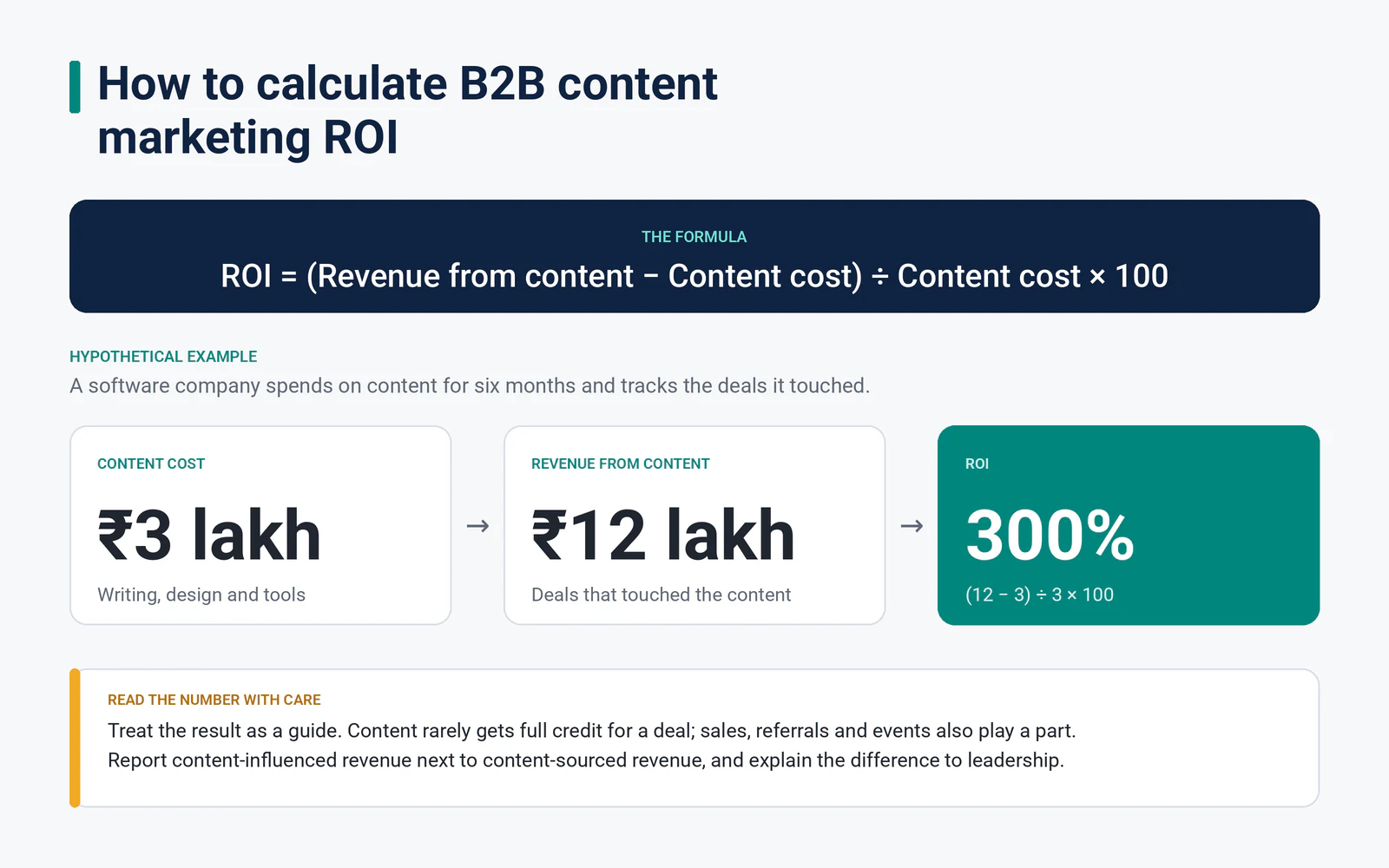
Also set expectations. Authority builds slowly. Rankings and engagement move first. Revenue follows months later.
Chapter 7: B2B content operations: team models, tools, and pitfalls
In-house, agency, or hybrid: Which B2B content model fits best?
A hybrid model works well in practice. Your experts supply the insight. A specialist team handles research, writing, SEO and publishing. Whatever you choose, keep one named owner for the strategy. If you want a partner for the work, Triserv360 builds and markets B2B websites and content programs.
Essential tools for B2B content marketing workflows
Start with free tools. Add paid ones when a real gap appears.
Best advice: You can do almost everything using Claude if you're on a budget — being a small or medium-sized business. You can improve your writing, generate graphics, perform SEO analysis, vibe code something quick.
What's important is having a strategy and confidence that what AI is saying — should be good to go or not. If you're not sure, hire someone who is an expert.
8 common B2B content marketing mistakes to avoid
1. Publishing without a goal
Publishing four blog posts a month feels productive, and it keeps the calendar full. Without a clear target, it is just busywork. According to the Content Marketing Institute (CMI) 2027 B2B survey, 65% of marketers felt more pressure to produce content faster over the past year, yet only 12% rated their overall marketing as highly effective.
- Example: A software company publishes 30 general articles on "remote work productivity" and gets 5,000 monthly visits, mostly from students and job seekers, with zero demo requests.
- The fix: Tie every piece to one specific outcome before you write, such as ranking for a high-intent buying keyword, helping sales answer a common objection, or driving sign-ups for a calculator.
2. Writing for everyone
A page written for "growing businesses" speaks to nobody. In B2B, an average buying group includes around 10 people across different roles, and each one cares about a different problem. Generic advice gets ignored because no reader feels like the page was made for their job.
- Example: Instead of writing "How to choose accounting software," write "How a 150-person manufacturing CFO compares Tally vs. cloud ERP."
- The fix: Name the exact industry, company size, and job role in your title and first paragraph so the right buyer immediately knows they are in the right place.
3. Copying competitors
Many B2B teams look at the top three Google results for a keyword and rewrite the same points in slightly different words. If your article says what ten other sites say, buyers have no reason to remember you, and AI search tools have no reason to cite you. In CMI's 2027 research, 64% of marketers said useful, practical information builds trust, and 59% pointed to demonstrated expertise.
- Example: Ten agencies publish "7 tips for B2B SEO." The eleventh agency publishes "What we learned auditing 40 B2B SaaS websites in India (with real traffic numbers)." That eleventh post gets bookmarked, shared, and cited.
- The fix: Add one thing competitors cannot copy, such as your own project data, real cost ranges, screenshots, or a lesson from a mistake you fixed.
4. Skipping sales input
Marketing teams often guess what buyers care about while the sales team hears the real objections on calls every single day. When marketing and sales work in silos, content ends up answering basic awareness questions while deals stall over pricing, security, or switching risks.
- Example: A sales rep hears "Your setup takes too long" on four calls a week, yet the blog has zero articles explaining the onboarding timeline.
- The fix: Spend 30 minutes a month asking your sales team for the top three questions or pushbacks they heard that week, then turn each one into a public guide or one-pager.
5. Hiding everything behind forms
Gating every guide, checklist, and report behind a lead form used to be standard practice. Today, it backfires. Research from 6sense shows that only 35.2% of buyers use their real contact details on forms, and Gartner found that 67% prefer a rep-free buying experience. Worse, search engines and AI tools like ChatGPT and Perplexity cannot read content locked behind a form, so gating your best insights makes you invisible in AI answers.
- Example: A company locks its best industry benchmark report behind a 7-field form. Downloads stay low, and zero AI tools cite the data. Another company publishes the full report openly on a web page and offers a downloadable Excel template as an optional bonus.
- The fix: Keep your best guides, comparisons, and original research completely open. Only gate high-effort tools like ROI calculators or ready-to-use templates.
6. Ignoring distribution Hitting "publish" is only half the work. A well-researched guide with no promotion plan quickly becomes part of a content graveyard that nobody reads. With nearly 60% of Google searches ending without a click, waiting passively for organic traffic is no longer enough.
- Example: A team spends 15 hours writing a deep comparison guide, shares the link once on its company LinkedIn page (where reach is low), and moves on to the next post.
- The fix: Plan distribution before you draft. Turn one guide into a founder LinkedIn post, a 5-slide carousel, a newsletter section, a short video clip, and a link your sales team can send in live email threads.
7. Forgetting to update old content Stats age fast, screenshots go out of date, and competitors publish newer guides. Leaving a "2023 Guide" untouched in 2027 signals to both buyers and search engines that your site is neglected. Outdated numbers also make AI tools less likely to trust and cite your page.
- Example: A B2B blog post ranking at position 3 loses half its traffic over a year because a competitor published an updated version with fresh benchmarks and current pricing.
- The fix: Review your top 10 traffic and conversion pages every six months. Update old statistics, replace broken links, add answers to new buyer questions, and update the publish date honestly.
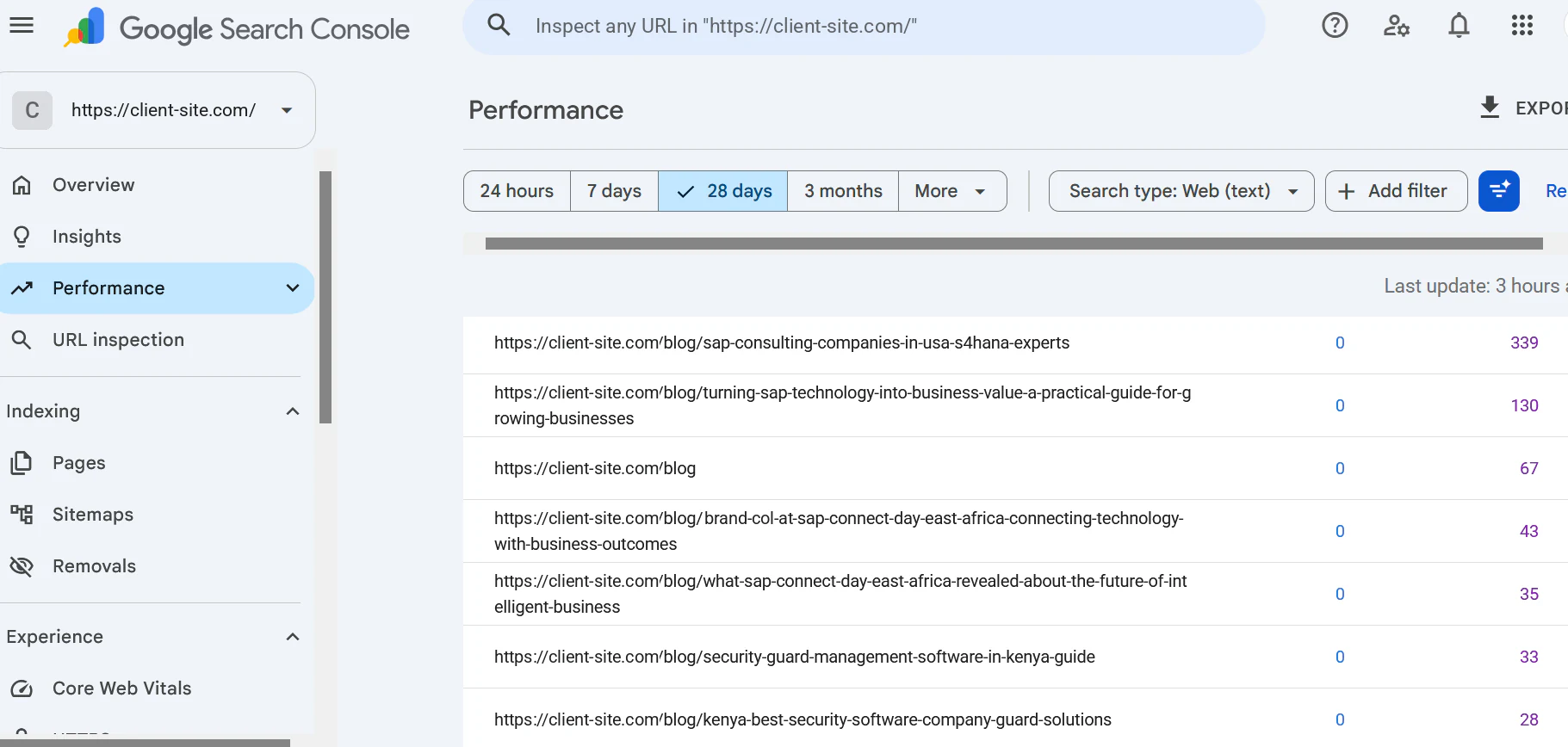
For instance, we recently updated our clients old blogs before we published the new one. We updated internal links, expanded content, added graphics, added more value in the content and submitted for index and within days, we started showing up in the searches for older content. Imagine that.
8. Judging results too early
B2B buying cycles often take three to six months or longer, and search authority builds gradually. Many leaders cancel a content program after six or eight weeks because it has not closed deals yet, right before the pages start ranking.
- Example: A company publishes eight strong bottom-of-funnel articles in Q1, sees minimal pipeline in month two, and stops publishing. By month five, those same articles reach page one and bring in five qualified demos, with no new content ready to follow up.
Plus there's a lot of nuances. For instance, you put out a great blog and it started ranking number 1 after just few hours but the ranking dropped in few days. What does this mean? Your content was no valuable?
That's not true, because search engines might rank you top initially because you created a guide that actually offered a lot of value but search engine takes few days or week to decide the actual rankings.
By no means it meant your blogs was bad. Just be more patient. That's why your SEO team expects a lot of trust from you because SEO is not a one-day job.

- The fix: Set clear expectations before you start. Track early signals like impressions, keyword movement, and sales usage in months one to three, and give each topic cluster at least two full quarters before judging revenue impact.
Chapter 8: real-world B2B case studies, 2027 trends, and your 90-day action plan
Everything in this guide comes down to one outcome: earning buyer trust before your sales team ever gets on a call. To show what that looks like in practice, we will start with three real B2B client projects and the content lessons behind them, look at six shifts reshaping 2027, and wrap up with a 90-day roadmap you can execute immediately.
What our real B2B client projects taught us about content
We build websites, apps and marketing programs for B2B companies. Three projects shaped how we think about content. Here is what each one shows.
Lesson 1: Show technical depth before the first sales call (A-Softech)
A-Softech had real expertise and a thin online presence. Enterprise buyers often check a partner online before they make contact. A thin site makes them assume a thin firm. Give each service its own page, with detail on who it is for, how the work runs and what the buyer gets. Then support those pages with posts that answer the questions buyers ask.
Lesson 2: Make product and catalog information easy to find (MRC)
MRC's buyers wanted to compare products and place bulk orders without long back-and-forth. Search, filters and clean categories gave them that. Apply the same idea to your content. Group articles by topic. Add a search box. Link each guide to the next logical question.
Lesson 3: Turn complex B2B services into clear structure (Acxiom Consulting)
Acxiom Consulting sells services that are technical and hard to compare. We organized them so a decision maker could see which service fits which problem. If your offer is complex, write one clear page per service, add the industries you serve and place a relevant case study beside each.
Audit your own B2B website in 30 minutes
Use the three lessons as a quick audit:
- Pick your top service. Does it have its own page with real detail?
- Ask a colleague to find a specific answer on your site. How many clicks does it take?
- Open your services page. Can a stranger tell which service fits their problem in under a minute?
- Look beside each service. Is there a case study or proof point?
- Check your social profiles. Do the last five posts answer a buyer question?
Fix the weakest answer first. Then repeat the audit next quarter.
4 B2B content marketing examples across industries
These examples are hypothetical. They show the thinking, so you can adapt it.
A logistics software company: The team asks sales for the top 20 buyer questions. They publish one honest guide per question, such as "How to cut late deliveries by routing smarter." Sales sends each guide in live deals. In six months, three of the guides appear in most won-deal notes.
A cybersecurity consultancy: The founder posts one lesson a week on LinkedIn from real audits. She turns the best posts into a monthly newsletter. Inbound calls start to mention her posts by name.
A construction contractor: The company writes a plain-language guide to tender documents and a checklist for judging bids. Procurement teams download the checklist, and the company is invited to bid more often.
An IT services firm: The firm publishes case studies with named clients, the problem, the fix and the result. It also builds comparison guides for each service. Buyers arrive on the pricing page already informed.
The pattern is the same each time. Each team starts with a real buyer question, answers it with first-hand knowledge and puts the answer where buyers look.
6 B2B content marketing trends to watch in 2027
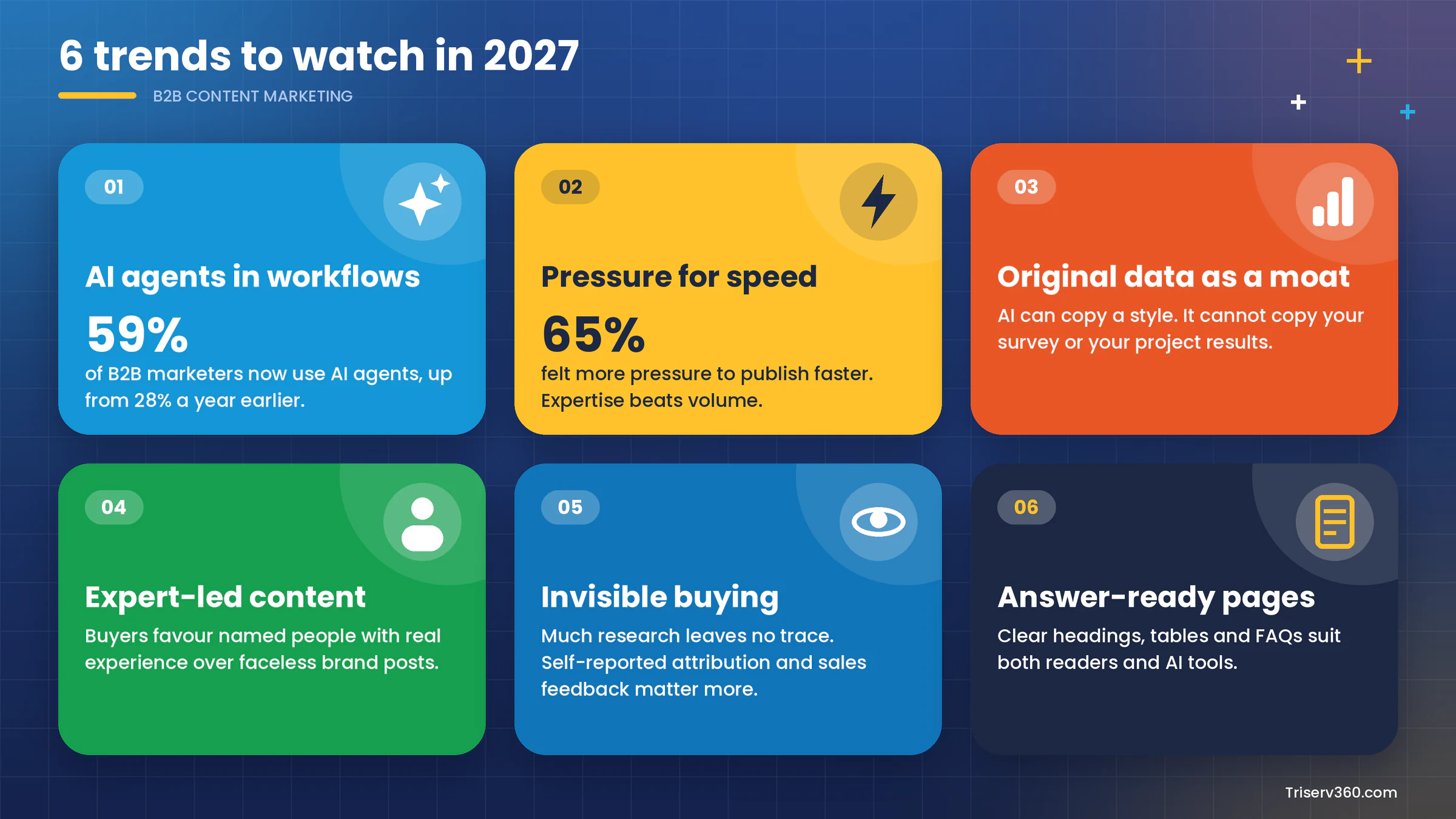
AI agents in content workflows: CMI's 2027 survey data shows 59% of B2B marketers now use AI agents, up from 28% a year earlier. Teams that add human review will get more value.
More pressure for speed: CMI found that 65% of B2B marketers felt more pressure to produce content faster over the previous 12 months. The teams that resist volume and focus on expertise will stand out.
Original data as a moat: AI can copy a style. It cannot copy your survey or your project results.
Expert-led content: Buyers favor named people with real experience over faceless brand posts.
Invisible buying: Much research leaves no trace. Self-reported attribution and sales feedback will matter more.
Answer-ready pages: Pages with clear headings, tables and FAQs suit both readers and AI tools.
Your first 90 days: B2B content marketing execution roadmap
Use this plan to start small and build momentum.
Frequently Asked Questions About B2B Content Marketing
What is B2B content marketing?
B2B content marketing is the creation of useful content, such as guides, case studies and videos, to attract and win business buyers. It builds trust before a sales conversation and supports the buyer through a long decision.
How is B2B content marketing different from B2C?
B2B content targets groups of decision makers with long buying cycles. It focuses on proof, detail and trust. B2C content targets individual consumers and often uses emotion and speed.
What are the best types of B2B content?
The most effective types are pillar guides, comparison pages, case studies, original research, webinars, LinkedIn posts and email newsletters. The best mix depends on your goal and your buyers.
How long does B2B content marketing take to work?
Engagement and rankings often move within weeks to a few months. Pipeline results usually take two to four quarters. Authority builds slowly, so set expectations with leadership early.
How often should a B2B company publish content?
No platform sets a required frequency. Publish as often as your team can keep up with quality, for a full year. For many small teams, that is one to two strong pieces a week at most.
How do you measure B2B content marketing ROI?
Set a baseline first. Track leading indicators such as rankings and engagement. Then track lagging ones such as content-influenced pipeline and revenue. Use the formula (revenue from content − cost) ÷ cost × 100, and add self-reported attribution.
Can small businesses and agencies compete in B2B content marketing?
Yes. Small teams win by going deep on a narrow topic where they have real experience. Low-volume, high-intent keywords are easier to rank for and often bring better leads.
Should B2B companies gate their content?
Gate only a few high-value assets, such as original reports or templates. Keep most guides open, so search engines, AI tools and buyers can read them freely.
How does B2B content marketing work with SEO?
Content gives search engines pages to rank. SEO helps buyers find those pages. Both work best when built around real buyer questions, clear structure and proof of expertise.
Is AI search replacing SEO for B2B?
No. 6sense found that 81% of buyers use LLMs, yet only 17% to 21% call them influential in the final decision. Strong SEO content also supports AI visibility, so invest in both.
TL;DR
Everything you'll ever need when it comes to content marketing complete guide. From basic to deep down the rabbit hole.
Got a project in mind? Let's talk!
Connect with our architects for a high-performance evaluation, technology modernization blueprint, or custom engineering strategy.